Food Delivery Robots
No longer a thing of the future, food delivery robots are here and being used in cities around the world. Can they save your restaurant money on delivery costs? Let's look at how they work and how to get in on the action.
.webp)
loading...
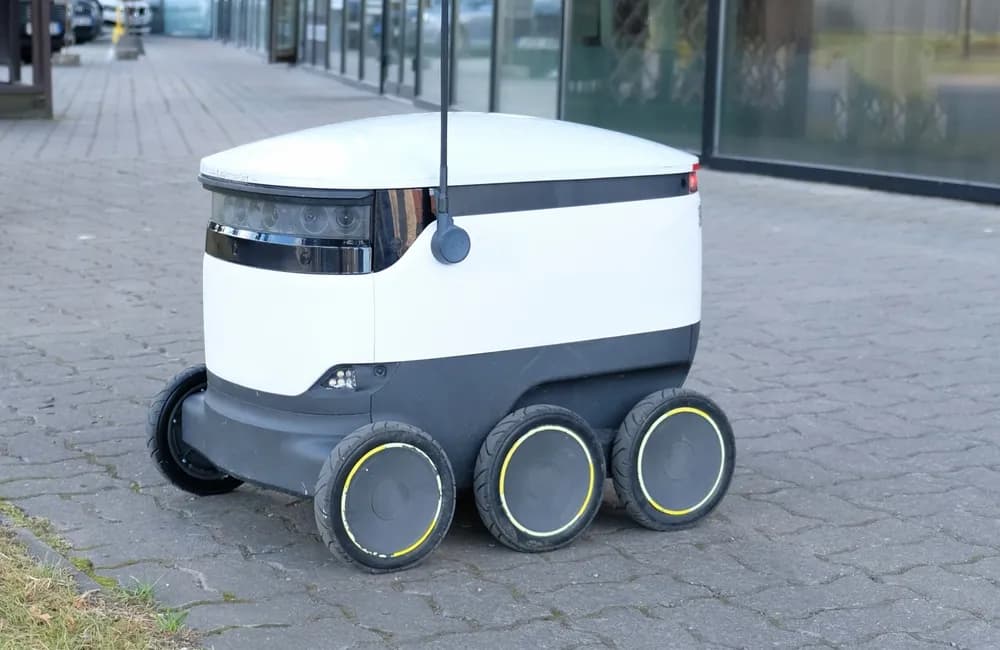
The box-shaped operators are designed to navigate sidewalks and streets, delivering food directly to customers.
You’ve already signed up for Uber Eats. You pay for DoorDash promos. So when you hear about a food delivery robot, you don’t think sci-fi—you wonder: Can this cut my costs or get me more orders?
Today, there are about 2,000 robots roaming U.S. sidewalks and campuses, delivering food, groceries, and packages. The market for robot food delivery (autonomous or semi-autonomous) was worth roughly $185 million in 2024 and is projected to grow nearly tenfold by 2033.
If you could reduce your delivery cost, serve more customers a little farther away, and run fewer late-night shifts, would you try a food delivery robot? Let’s look at what it takes — costs, service areas, risk —and whether you’re ready.
What are food delivery robots? (top)
Food delivery robots are compact electric machines that transport meals directly from your kitchen to a customer's doorstep. Typically, they are found moving on sidewalks or campus pathways, and they usually operate at walking speed.
These robots depend on sensors like cameras, GPS, and LiDAR for guiding themselves and avoiding people, animals, and vehicles. Though fully automated, they still have human officials who supervise and are always ready to intervene if necessary.
Upon the robot's arrival, the customer is notified via a mobile alert. The product is placed in a locked compartment from which it can only be accessed with a code or via an application, thus ensuring the order's safety until pickup.
Robots delivering food can offer a steady service with fewer scheduling problems, instead of you solely depending on gig drivers.
Key points for restaurant owners:
✅ Electrically powered with low operating costs
✅ Sensors and GPS help to locate them and keep them safe on sidewalks
✅ Orders are secure until the customer opens the compartment
✅ Human operators monitor remotely to avoid any service interruptions
Where to buy food delivery robots? (top)
If you are a restaurant owner in the United States, you do not have to wait years for this breakthrough technology. The robots for food delivery are at your disposal. Three methods are purchasing, renting, or cooperating with service providers.
Needless to say, an outright purchase gives you complete control. You are the one who makes decisions regarding the use of the robots, whether they are operated during the day or at night, and you also get to keep the money coming from the deliveries. This option entails a more expensive upfront investment and the obligation of keeping the equipment in good shape.
By way of renting or leasing, it is much simpler to work out a budget. These two firms — namely Roborent and Kiwibot — are the ones that provide the possibility of signing contracts of different durations. You take all the advantages of the robot food delivery, with the exception of ownership.
By partnering with providers, you arrive at the lowest-risk entry point.
Here’s a breakdown of the current players:
| Company | What they offer |
|---|---|
| Kiwibot | Autonomous delivery robots for campuses and cities, rental models available |
| Alibaba.com | A broad marketplace of food delivery robots from multiple manufacturers |
| Starship Technologies | Large-scale fleets for grocery, campus, and app-based delivery |
| Avride | Delivery services for businesses and neighborhoods using robots |
| Coco Robotics | Delivery robots operating in major U.S. cities like Los Angeles |
| Serve Robotics | Urban-focused food delivery robots are often integrated with delivery apps |
The decision is about how fast you want to move. If you're ready to commit, buying or renting can put your brand ahead of competitors. If you prefer to test with less risk, partnering with existing providers gives you an immediate way to see how customers respond to robots delivering food in your market.
Where do the robots live? (top)
Most food delivery robots are not at the restaurant all the time.
The way it is set up depends on the model and the service provider.
✅ Owned or leased robots – If you purchase or lease robots, they are regularly kept at your restaurant or in a storage place that is close by. They get recharged on docking stations, similar to the way you would do it for electric scooters or cleaning robots.
✅ Robots provided by partners – If you are associated with companies like Starship Technologies or Serve Robotics, the robots are in local hubs, which are under the management of the provider. They are sent into your service zone at the agreed operating hours. You don’t have to store them or be concerned about logistics.
How are the robots maintained and upgraded? (top)
Maintenance is the main point, and again, it depends on the model of the robot.
✅ If you buy or lease, you or your staff will have to do daily activities such as charging the robots, cleaning the compartments, and making sure that the wheels and sensors are free. The bigger repairs, software updates, and hardware upgrades are done by the manufacturer or supplier.
✅ If you partner with a provider, maintenance and upgrades are just not in your plan. Companies like Starship or Coco Robotics do it for their own fleets. They remotely install software updates and change hardware that needs to be replaced. Your job is just to bring their delivery flow into your restaurant.
Food delivery robot price (top)
The price of a food delivery robot varies based on whether the user buys, leases, or partners with the supplier. If you purchase the robot directly, a smart sidewalk robot will set you back somewhere between $2,500 and $5,000. These are small robots, which are battery-powered and woven at the rate of about 4 mph (6.4 km/h), which is very close to the walking speed of a human being.
In the case of some high-end models, the price might be above $10,000 if the advanced navigation system, the extra battery life, and the more robust storage compartment are considered. Leasing and subscription models (robot-as-a-service) usually start from $1,000 to $2,500 per month, the exact amount depending on the size of the fleet, the support, and the service area.
How to determine what is a fair price for the equipment or service (top)
A “fair price” isn't just about the sticker price of the robot. You need to look at the total cost of ownership or the true cost of service. Here's how to break it down:
1. Calculate the Total Cost of Ownership (TCO) (top)
Equipment costs:
✅ Initial purchase: The upfront cost of the robot itself.
✅ Operating costs: Charging (electricity), insurance, and possible connectivity fees.
✅ Maintenance: Repairs, software updates, preventative servicing, and parts replacement.
✅ Wear and tear: Wheels, batteries, and sensors eventually need replacement.
Service costs:
✅ Labor: If your staff is involved in loading, unloading, or monitoring.
✅ Overhead: Storage space, charging stations, or IT systems that support the robots.
2. Consider market factors (top)
✅ Market demand: If your area has a strong appetite for faster, cheaper delivery, you may be able to pass higher costs onto customers.
✅ Competitor pricing: Look at what other restaurants or nearby delivery options cost. Robots should give you a cost advantage, not a disadvantage.
✅ Condition of equipment: New robots demand higher prices, but used or leased units can reduce entry costs.
3. Add a profit margin (top)
A common method to pad on a profit to the cost of labor and materials is cost-plus pricing. For example, if your robot delivery costs average $4 per order and you want a 0.2 margin, you’d need to charge at least $5 per order to stay profitable.
4. Determine the right value (top)
✅ Salvage value: What you can sell or trade the robot for at the end of its useful life.
✅ Downtime: Periods when robots are charging, offline, or under repair reduce service availability. Factor that into your pricing so you’re not undercutting yourself.
If you want full control and have the cash flow, buying a robot at $2,500 to $5,000 can pay off in a year or two, depending on delivery volume. If you’d rather keep costs flexible, leasing or partnering with a provider spreads the risk. The “fair” price is the one that fits your customer base, demand level, and ability to absorb or pass along costs.
Just be sure to read the auction terms carefully and ask about inspection days or preview sessions. These allow you to view the product before you decide to purchase it.
How to Protect Your Investment (top)
In the event you purchase a delivery robot, it is equally important to take steps to safeguard that investment. By acting in a preventive manner, you are ensuring continuous functioning, saving up for a longer life, and also a quicker return on your investment.
Final Thoughts: Is It Worth It? (top)
Food delivery robots are no longer experimental — they’re operating in U.S. cities and campuses today. For restaurant owners, the question isn’t whether they work, but whether they fit your business model.
Buying robots requires a higher upfront investment and ongoing maintenance, while renting or partnering lowers the barrier to entry but gives you less control.
The real value comes down to your delivery volume, your local service area, and your willingness to manage both the tech and the logistics.
For some restaurants, especially those in dense areas with consistent delivery demand, robots can reduce costs and provide a marketing edge. For others, traditional gig drivers may still be the more practical option — at least for now.
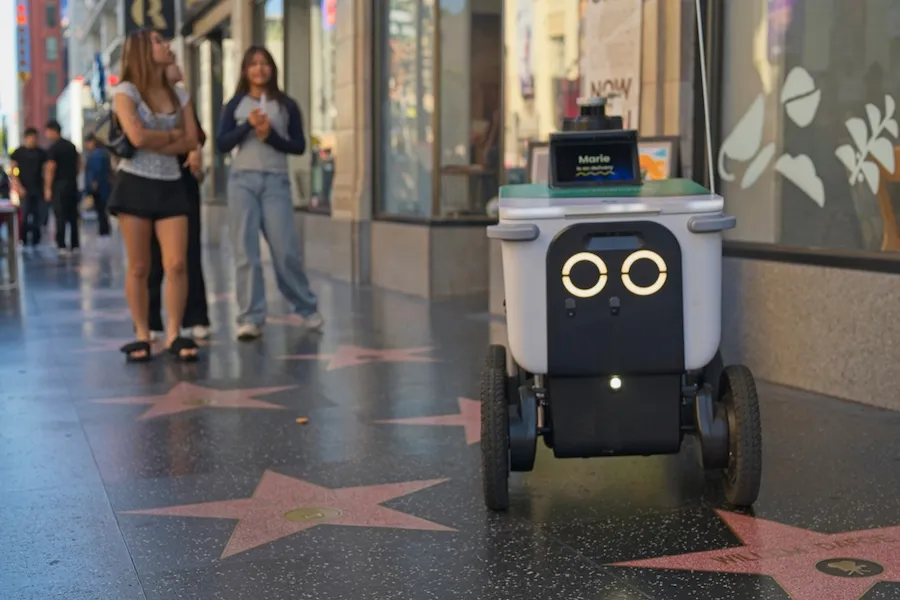
A food delivery robot demonstrates its ability to navigate complex urban environments, showcasing the potential for automation in the food delivery industry.
©2025 Cocina Digital Hospitality Group, Inc. All rights reserved.
No part of this publication may be reproduced, stored in a retrieval system, or transmitted in any form or by any means, electronic, mechanical, photocopying, recording, or otherwise, without the prior written permission of the publisher.