Restaurant Success Deconstructed: In-N-Out Burger
How does a privately owned burger chain achieve cult-like status and maintain quality across all locations? This in spite of the burger titans such as McDonald's and Carl's Jr. Let's explore the secrets behind In-N-Out's success.
.webp)
loading...
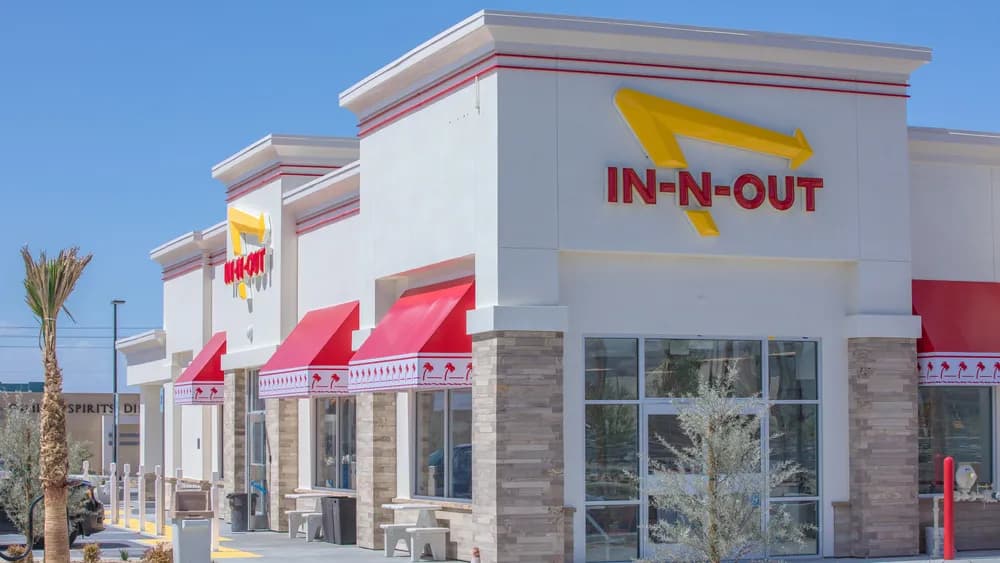
Even after 75 years, In-N-Out Burger remains a beloved burger chain throughout the south western United States.
In-N-Out Burger is much more than a popular fast-food chain: it’s a cult favorite institution in America.
Its success seems paradoxical because it has managed to stand out in a world full of aggressive expansion strategies, trendy menu items, and evolving food concepts.
In-N-Out Burger, on the other hand, has stuck to a minimal menu and become profitable without franchising or going public.
We are deconstructing the success story of In N Out as a case study of strategic discipline over rapid growth.
By the end of this article, we will have multiple takeaways and lessons for restaurateurs to understand how this family-owned empire has outperformed numerous public competitors and succeeded without the traditional scaling strategy.
What Lessons Can We Learn from In N Out?
In N Out Burger was founded in 1948. It has now grown to over 380 locations across eight different states while maintaining customer loyalty, industry-leading employee retention, and massive profit margins.
What makes In N Out’s success remarkable is that its growth often comes from saying no to many obvious opportunities, such as going public.
Restaurant owners can draw lessons from In N Out’s history to navigate growth decisions, franchise opportunities, and employee management challenges.
You can take inspiration from In N Out leadership’s strategic choices to build a sustainable and successful business through disciplined decision-making instead of hopping on every expansion opportunity.
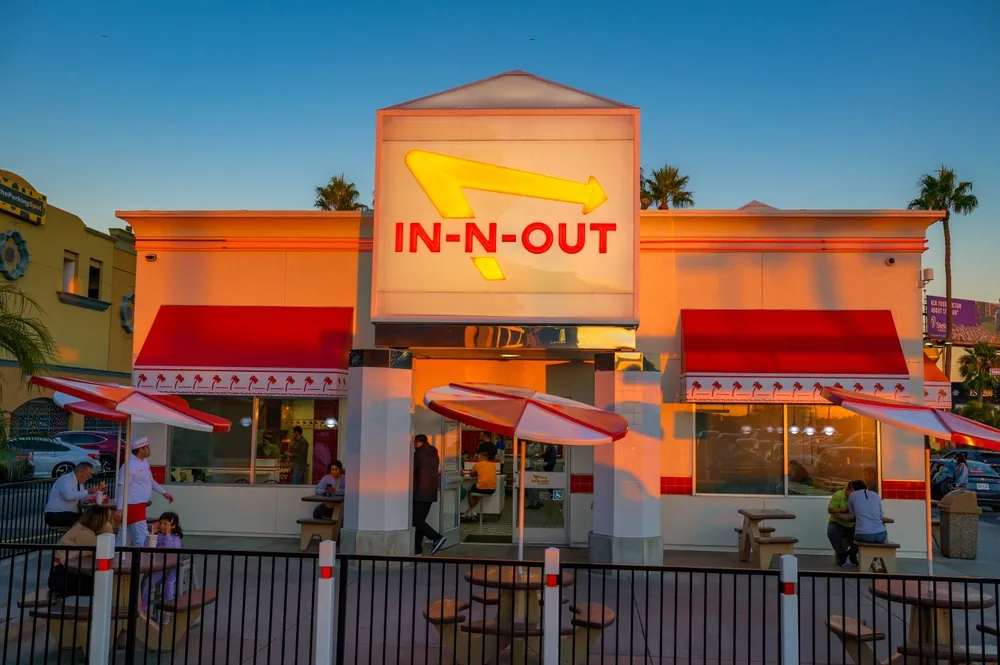
Incredibly, the modest footprint of an In N Out Burger location can serve thousands of customers efficiently.
History of In N Out Burger
The In N Out history starts in Baldwin Park, California, in 1948, when Harry and Esther Snyder opened California's first drive-thru hamburger stand.
Even at that time, In N Out managed to stand out from the other post-war restaurant startups by introducing a two-way speaker system through which customers could order without leaving their cars.
Harry Snyder became the pioneer of the drive-thru concept.
At that time, most restaurants were copying the same car-hop model, but Harry Snyder decided to bring innovation to offer a better customer experience.
This is early adoption of technology at very start of the In N Out Burger existence gives an important lesson that restaurant owners can achieve breakthrough success by solving customer problems via innovative solutions.
Moreover, the original In N Out location was a small 10-by-10-foot burger stand. But the Snyders differentiated themselves from the competitors by focusing on quality ingredients and fresh preparation in comparison to frozen patties and processed ingredients.
The history of In N Out also reveals that from day one, the Snyder family has prioritized product quality over cost-cutting.
This decision is still seen in In N Out operations today and has given it a massive competitive advantage.
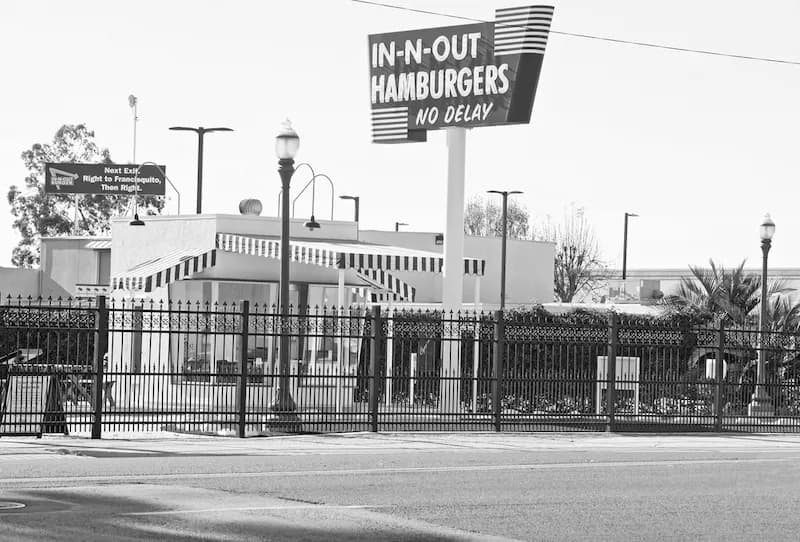
The original In-N-Out Burger location was demolished to make way for construction of Interstate 10. However, a replica (above photo) was built in Baldwin Park, California.
Foundation of In N Out
The first three decades of In N Out Burger's history involved measured growth.
By 1976, when founder Harry Snyder passed away, the company had just 18 locations, all in Southern California. This kind of slow growth was actually part of the strategic positioning that helped the brand become a huge success.
This brings us to another key lesson of achieving market domination before expansion. Many businesses feel compelled to rush into new markets without streamlining their operations and building customer loyalty.
Restaurant owners can apply this lesson by dominating their local market before considering expansion
Rich Snyder, one of the sons of the founders, assumed leadership of In N Out in 1976 and accelerated its growth while maintaining the family’s core principles.
The chain grew from 18 to 93 locations while establishing its own distribution systems and operational procedures.
This highlights the importance of infrastructure in establishing a successful restaurant.
Rich Snyder did not open any In N Out branch outside the daily delivery range from the distribution centers to ensure consistent quality.
The lesson to be learned? Restaurant owners should always consider their operational capabilities while making growth decisions.
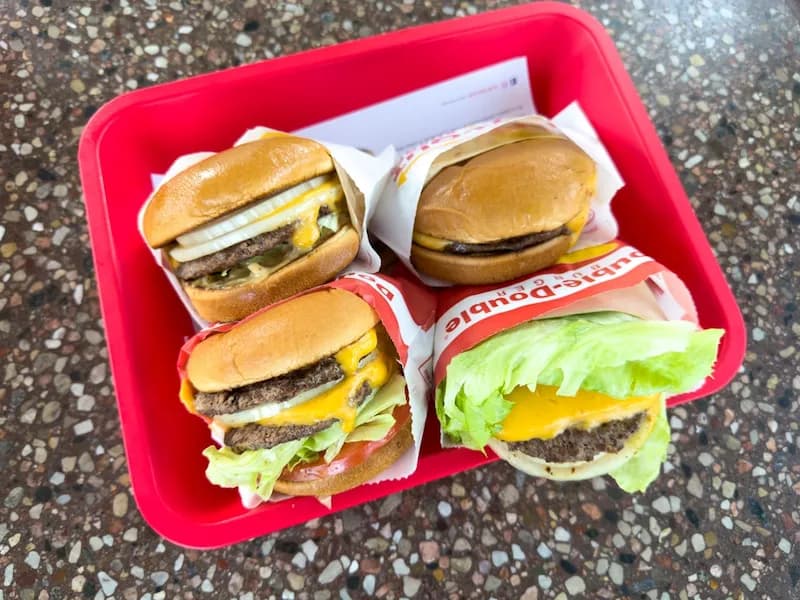
Consistency and fresh ingredients have been key to In-N-Out's enduring popularity.
Trajectory of In N Out Success
In N Out Burger has focused on simplicity since its inception. Unlike other food chains, In N Out has not dabbled in international expansion or extensive menus to maintain a highly controlled operation that offers consistent quality and customer satisfaction.
The brand has accumulated a cult-like following that is not just repeat buyers, but also advocates. A lot of credit of In N Out’s success goes to the fact that it is a family-owned company.
In N Out Owner
The In N Out succession story shows how the food chain has maintained strategic consistency through leadership changes. Rich Snyder died in a plane crash in 1992, and his brother Guy led the company till his death in 1999.
The current owner of In N Out is Lynsi Snyder, the founder’s granddaughter. She became the company’s president in 2010 and has complete ownership.
The In N Out owner's net worth is about $7.3 billion, making Lynsi Snyder one of America’s youngest female billionaires.
Lynsi Snyder now runs the chain with the founding principles, along with a focus on modernizing operations.
Knowing who is the owner of In-N-Out Burger is important because family ownership has allowed the food chain to have long-term strategic thinking instead of operating under the pressure of public ownership.
Critical Elements of In N Out’s Success
Here are the key elements that have fueled In N Out’s success:
1. Simple Menu Philosophy
The menus of most food chains like McDonald’s have evolved and expanded drastically over the years. The In N Out menu, however, has remained virtually the same since 1948.
This simple and easily memorable menu includes hamburgers, cheeseburgers, Double-Doubles, fries, and beverages. This simplicity plays a vital role in operational efficiency, maintaining quality, and faster service.
The famous In N Out secret menu adds customization options without any complexities. This menu includes items like In N Out animal style burgers and animal style burger In N Out fries made from the existing ingredients.
Having knowledge of the secret menu creates a sort of insider status among customers and drives loyalty, so you can also consider replicating this in your restaurant.
It also teaches the lesson that maintaining a limited, but high-quality menu is useful to achieve superior execution instead of a broad selection.
In this way, quality becomes the main differentiator instead of variety.
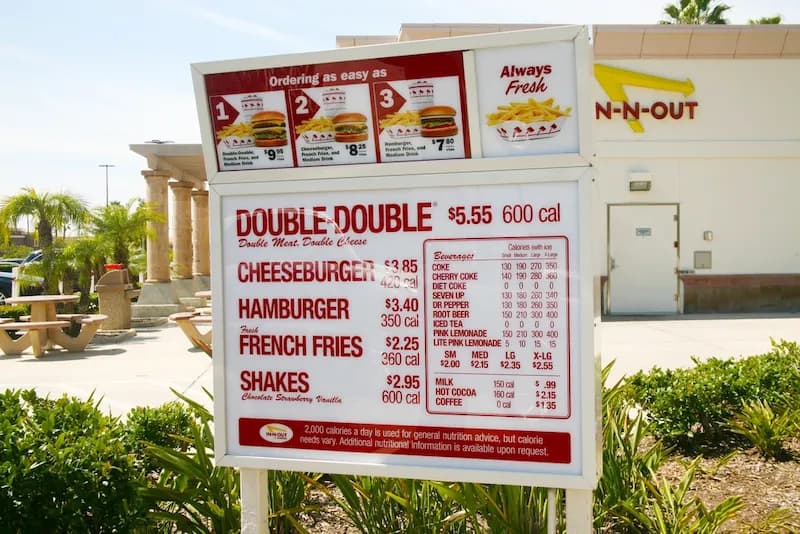
The menu items at In-N-Out have largely remained consistent over the years.
2. Private and Family-Owned Business
In N Out Burger's decision to remain private and family-owned has really worked in its favor.
Its direct competitors, like McDonald's and Burger King, have gone public to ensure rapid expansion, but the Snyder family has complete ownership of the brand.
This decision is useful to avoid shareholder pressure and make long-term plans without chasing quarterly earnings.
Restaurant owners should carefully consider their own working situation and determine the impact of ownership structure on their ability to run a business.
For instance, if an individual has a unique long-term vision for their restaurant, they can consider having full ownership, while a public ownership structure is more suitable for owners looking for rapid and global expansion.
3. Excellent Employee Benefits and Salaries
In N Out is renowned for having an excellent employee benefit program in addition to paying above market rates. This is a major differentiator because the restaurant and food industry is typically known for minimum wages and high turnover.
For example, In N Out Burger manager's salary is about $160,000 annually. Similarly, the starting wage at In N Out is estimated to be $17 per hour with comprehensive benefits and advancement opportunities.
Overall, this type of employee investment points to the lesson that high compensation costs are strategic investments that businesses have to make to minimize turnover and improve service quality.
It also creates a sustainable competitive advantage through high-quality human capital. Restaurants should evaluate whether labor costs generate greater returns by offering a better customer experience.
4. Supply Chain Control
In N Out is strongly committed to fresh ingredients through its extensive supply chain control. It does not use freezers, microwaves, or even heat lamps at any of its locations.
It means all the burgers are made with fresh ingredients.
In N Out Burger is able to use fresh ingredients by making sure all of its locations are within a day’s drive of its regional distribution centers. The brand is also able to justify higher prices through superior product quality.
This shows that restaurant owners should evaluate the importance of quality investments in their own establishments and determine if they can create sufficient pricing power and customer loyalty to overcome the higher operational costs.
5. No Franchising Policy
While the food industry is full of examples of businesses that have achieved immense success with franchises, like McDonald's, In N Out has managed to do it with direct ownership.
This kind of business model sacrifices growth for operational control, but it brings consistent quality and brand protection.
This gives an important lesson in preferring control over speed.
By maintaining the direct ownership of all 380+ locations, In N Out has managed to ensure brand consistency and establish itself as America’s most favorite burger chain.
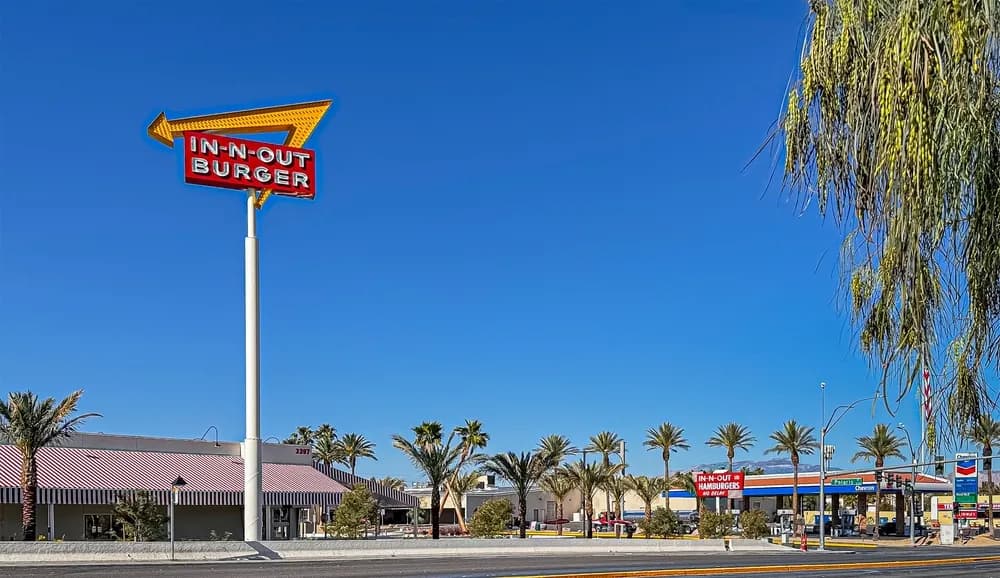
A tall highway sign for an In-N-Out Burger location in Las Vegas, Nevada. All In N Out locations are company owned.
Lessons Restaurants Can Learn from In N Out’s Success
We’ve already discussed multiple lessons that you can learn from In N Out’s history and success. But let’s dive in to see what restaurant owners, food entrepreneurs, and industry professionals can learn from In N Out Burger’s success:
1. Importance of Consistency
The In N Out menu has been consistent since its formation. It has rarely changed over the last 70 years.
It means they have not chased trends, but instead doubled down on their specialties that include burgers, fries, and shakes.
Such kind of simplicity and consistency bring operational efficiency, customer satisfaction, and quality control.
Who this applies to:
✅ Independent restaurants and local brands aiming to build a loyal base
✅ Businesses with limited resources that want to focus on product quality
Who this may not apply to:
⛔️ Large-scale chains that rely on trends to attract customers
⛔️ Businesses in saturated urban markets where variety is vital for customer retention
2. Controlled and Stable Growth
Instead of having rapid national or international growth, In N Out has focused on slow expansion, especially while establishing its supply chain of fresh ingredients. It helped the brand maintain product freshness.
Who this applies to:
✅ Regional restaurant owners who want to scale without compromising quality
✅ Entrepreneurs willing to dedicate years to a venture without aggressive expansion
Who this may not apply to:
⛔️ Venture-backed restaurants expected to scale aggressively to make quick profits
3. Complete Ownership of Your Restaurant
In N Out has remained a family-owned private company. It can make long-term decisions without shareholder pressure.
Moreover, they’ve resisted franchising, even if it results in slower revenue growth.
Who this applies to:
✅ Founders who want to preserve control and brand integrity
✅ Individuals more concerned with brand legacy and quality than quarterly profits
Who this may not apply to:
⛔️ Businesses that rely on external capital for scalability
⛔️ Companies aiming to gain market share and global domination through franchises
4. Strong Culture for Employees
In N Out pays its employees well above the industry average and often promotes from within. This has built a loyal workforce for the brand with low turnover and exceptional service.
All of these factors are integral to brand reputation.
Who this applies to:
✅ Restaurants that want to stand out through customer service and experience
✅ Owners who know the importance of investing in human capital to build a long-lasting brand
Who this may not apply to:
⛔️ Businesses operating in highly seasonal environments.
⛔️ Restaurants that outsource labor
5. Use Scarcity as a Branding Tool
In N Out Burger has 380+ locations, but they are primarily located in California and the southwestern United States. Limited geographic footprint has generated a cult following, and the brand has become iconic because of its scarcity.
Who this applies to:
✅ Brands that want to be premium and build exclusivity
✅ Restaurants that want to associate with a regional identity
Who this may not apply to:
⛔️ Large-scale brands that require extensive marketing to survive
⛔️ Chains are competing in a highly competitive and high-volume market.
Conclusion
In N Out Burger’s success is not built on flashy marketing campaigns. The food chain thrives on focus, control, and strong commitment to quality.
While most brands are built with always “doing more”, In N Out has stuck to its core principles of simplicity and focused on streamlining operations to cater to its base.
The key takeaways from In N Out Burger’s success are:
🍔 Quality and consistency are non-negotiable in a food business.
🍔 Building a strong company culture and taking care of the employees matter.
🍔 Controlled and sustainable growth can create brand scarcity, leading to higher demand.
🍔 Building mystique around your brand can turn customers into loyal fans and brand advocates
🍔 Other than the quality and operational nitty-gritty, the entire ownership structure matters. For instance, In N Out has used its structure of being private and family-owned as a strategic advantage.
In the end, it is important to remember that In N Out is successful not because it tries to satisfy everyone, everywhere.
Instead, the success has followed In N Out because it has committed to a few things and does them exceptionally well.
Learn from the success of In-N-Out Burger. Apply it to your own business strategy.
©2025 Cocina Digital Hospitality Group, Inc. All rights reserved.
No part of this publication may be reproduced, stored in a retrieval system, or transmitted in any form or by any means, electronic, mechanical, photocopying, recording, or otherwise, without the prior written permission of the publisher.