Restaurant Success Deconstructed: Carl's Jr.
What we know today as Carl's Jr. started in 1941 as a single hot dog cart in Los Angeles. It has since grown into a global franchise empire with over 3,800 locations worldwide. What are the key factors behind Carl's Jr.'s success and longevity in the highly competitive fast food industry? Let's find out in this deep dive analysis of Carl's Jr.'s history, growth trajectory, and critical success elements.
Abdullah M.
loading...
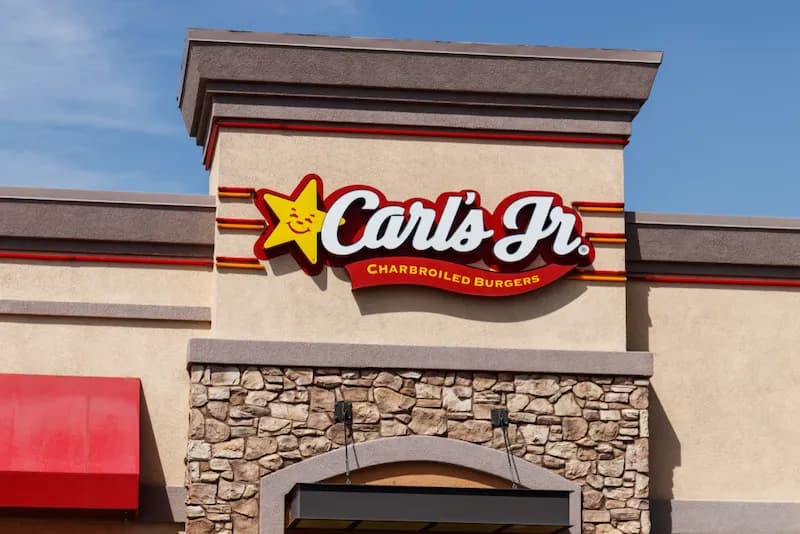
The familiar Carl's Jr. logo and branding have become iconic in the fast food industry.
The names of fast-food chains like McDonald’s and Burger King usually come to mind first when you think about the burger chains that have survived decades of industry turbulence.
However, there’s another player — Carl's Jr. — that has not only survived the infamous “burger wars,” but also thrived by being different in the industry.
Carl's Jr. has become a multi-billion dollar empire by being different than the restaurants that were too focused on serving the cheapest and fastest burgers.
The growth of Carl's Jr. from a single hot dog cart in 1941 to over 3,800 locations worldwide today makes it a great restaurant chain to dissect and understand the factors that make it so successful.
But first, let's learn about Carl's Jr.'s history.
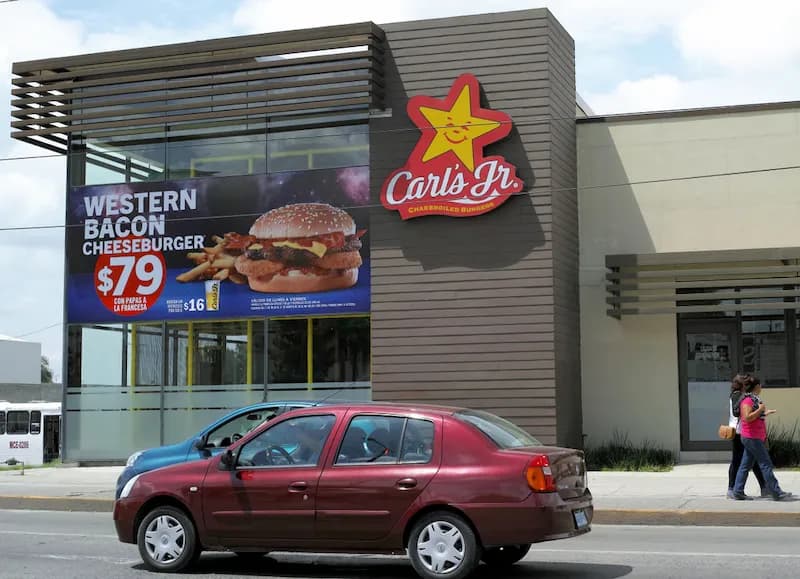
The exterior of a Carl's Jr. restaurant in Leon, Mexico.
Carl's Jr History and Origins
The history of Carl's Jr. starts with a story that sums up the American entrepreneurial spirit during World War II. Carl's Jr. was founded by Carl Karcher, a young farmer from Ohio who moved to California with $311 in his pocket and a dream to build something bigger than himself.
When Was Carl's Jr. Founded?
Carl's Jr. was founded in 1941 when Carl Karcher purchased a hot dog cart in Los Angeles for $311. It was the money he borrowed against his Plymouth DeSoto automobile.
He made the smart decision of positioning his cart on a busy street corner. Karcher quickly learned the importance of strategic location, excellent customer service, and high food quality, which later became the defining qualities of his empire.
However, it was not until 1956 that the Carl's Jr that we know emerged when Karcher opened his first full-service drive-in restaurant called Carl's Drive-In Barbecue in Anaheim, California .
It rebranded into Carl's Jr. in 1961 as a way to expand quickly with a streamlined menu and operations.
The Carl's Jr. Founder Story
Carl Karcher, the Carl's Jr. founder, is a classic American success story.
He was born in 1917 on a farm in Ohio. He moved to California during the Great Depression to work for his uncle's business.
Karcher's willingness to take calculated risks immediately set him apart from other founders. He strongly believed in treating both customers and employees well.
Margaret Karcher, who became Carl's business partner and later his wife, also brought operational discipline and customer service excellence into the business.
The couple's partnership is one of the key reasons why the business became so successful, especially during the early years.
Carl was focused on the expansion strategy, and Margaret managed day-to-day operations to ensure high-quality standards that differentiated their restaurants from competitors.
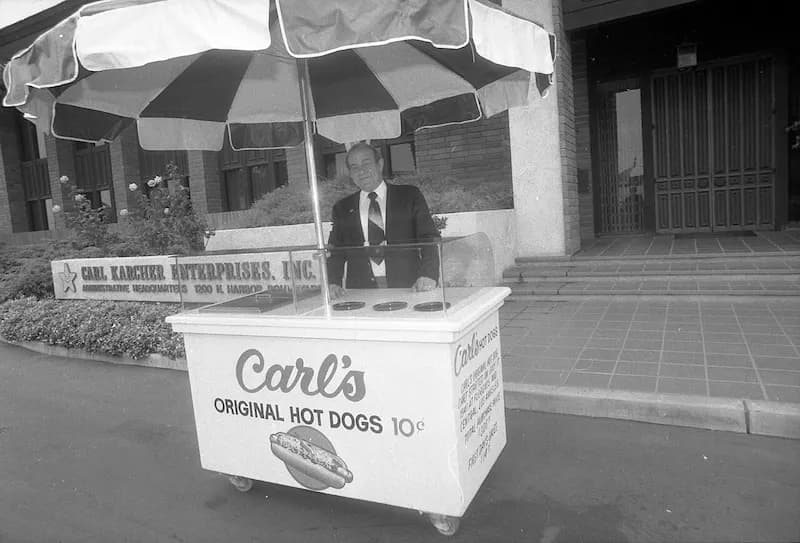
Carl Karcher, in 1981, with a replica of the original hot dog cart from 1941. Image credit: Los Angeles Times - https://digital.library.ucla.edu/catalog/ark:/21198/zz0002rv87 , CC BY 4.0 , Link
The Trajectory of Carl's Jr.
Carl's Jr. has gone through significant transformations over the years to become the highly successful empire that it is today. The early growth of Carl's Jr. turned it into a small empire of drive-in restaurants across Southern California.
It was also perfect timing for the restaurant to take its roots in California's growing car culture, when more and more families wanted quality food they could enjoy without leaving their vehicles.
Carl's Jr.'s history and success during this period show that the management understood the market.
These restaurants also focused on preparing food using fresh ingredients and cooking burgers to order, while many of the competitors were too focused on speed.
Karcher always insisted on quality, even at higher costs, which led Carl's Jr. to be a premium option in the fast food industry.
Surviving the Burger Wars (1970s-1980s)
The period of the 1970s and 1980s is known for the infamous “burger wars” when brands like McDonald's, Burger King, and Wendy's fought for their market share via aggressive marketing.
Brands like McDonald's had the unique proposition of efficiency, pricing, and standardization, but Carl's Jr. took a different approach to compete by offering bigger portions and fresher ingredients.
This position decision proved to be excellent as Carl's Jr avoided direct price competition while building a loyal base of customers who wanted something much more substantial.
Another important decision made by Carl's Jr founder during this period was that instead of competing nationally immediately, they first focused on dominating the West Coast market.
This kind of geographic concentration helped Carl's Jr build brand strength and operational excellence.
Corporate Transition
By the 1980s, it was clear that Carl’s Jr was too large to be managed by one person effectively.
Carl Karcher made a sound decision to bring in professional management by establishing CKE Restaurants (California Kitchen Enterprises)as the parent company.
This move allowed Karcher to step back from day-to-day operations. Such a transition is vital for the long-term success of any growing business, including a restaurant chain.
Hardee's Merger and National Expansion
In 1997, CKE Restaurants acquired Hardee's , which was a struggling East Coast burger chain at that time.
This was a turning point in Carl's Jr.'s history as it gave Carl's Jr instant national presence, and also provided Hardee's with proven operational systems.
The acquisition is also vital because it addresses one of the most common questions about the brand:
Are Carl's Jr. and Hardee's the Same?
Yes and no.
Carl's Jr. and Hardee's operate under the same parent company (CKE Restaurants). They also share many menu items, due to which many people think they are the same.
Moreover, they also share resources, including operational systems and corporate leadership.
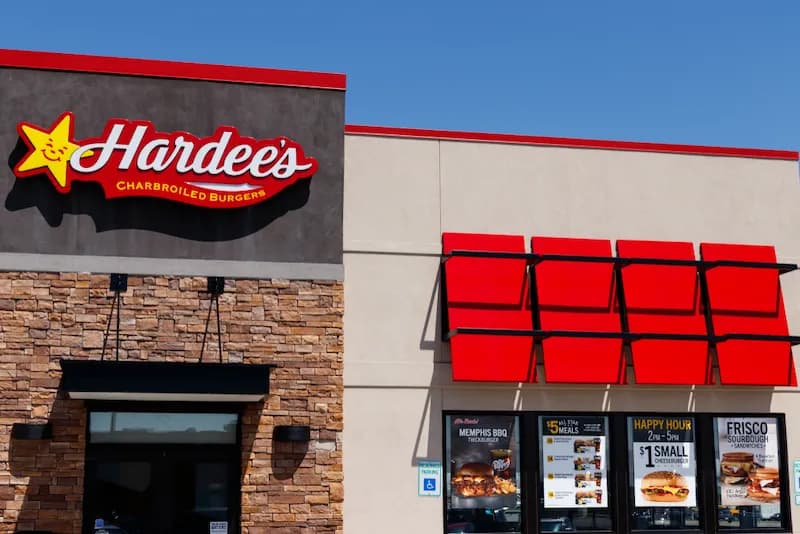
The exterior of a Hardee's restaurant. The chain was acquired by CKE Restaurants, the parent company of Carl's Jr., in 1997.
Yet, both Carl's Jr. and Hardee's have separate brand identities and some regional menu variations.
Overall, the deal-brand strategy has proven effective for CKE to compete nationally while maintaining regional brand loyalty.
Critical Elements of Carl's Jr.'s Success
Let's dissect the various factors that have contributed to Carl's Jr.'s longevity and success:
1. Bold Positioning
Carl's Jr.'s powerful positioning: “If you're hungry, we're your place,” has contributed immensely to its modern success. It reflects the brand's genuine commitment to serving larger and satisfying meals.
Moreover, the brand has embraced indulgence over the decades instead of being apologetic for the clear market position it has created.
Many chains have changed their menus to focus on healthier options or offering value pricing, but Carl’s Jr. continues to serve thick burgers, loaded fries, and milkshakes to customers who want a truly satisfying meal.
2. Controversial but Effective Advertising
Carl's Jr. commercial campaigns have generated a lot of discussion, both positive and negative, which is often much more than any other fast food chain.
The most famous example is the Carl's Jr. commercial Paris Hilton starred in during 2005, washing a car while eating a burger.

Celebrity endorsements have been a key part of Carl's Jr.'s advertising strategy, with Paris Hilton (above) being one of the most memorable examples.
The Carl's Jr ad with Paris Hilton was a huge success for the brand, and it even caused the Carl's Jr. website to crash due to massive traffic, as it became a national conversation.
The ad is one instance of a broad advertising strategy that focuses on creating memorable content that breaks through the noise of generic ads.
Whether featuring the Carl's Jr. commercial girl washing car or other provocative concepts, these campaigns serve a clear business purpose to position Carl's Jr as a bold and unapologetic choice for people.
3. Menu Innovation and Quality Focus
Many fast food restaurants keep adding more and more items to their menu.
Carl’s Jr, however, focused primarily on perfecting what they did best: premium burgers and indulgent sides.
Moreover, the brand company consistently invested in high-quality ingredients, such as Angus beef, fresh vegetables, and artisan breads, to justify premium pricing.
Recent innovations like the Carl's Jr. Beyond Burger show that the company is open to adapting to changing consumer preferences.
Even though Carl's Jr. Beyond Burger discontinued after getting mixed results, the experiment shows the brand's innovative mindset.
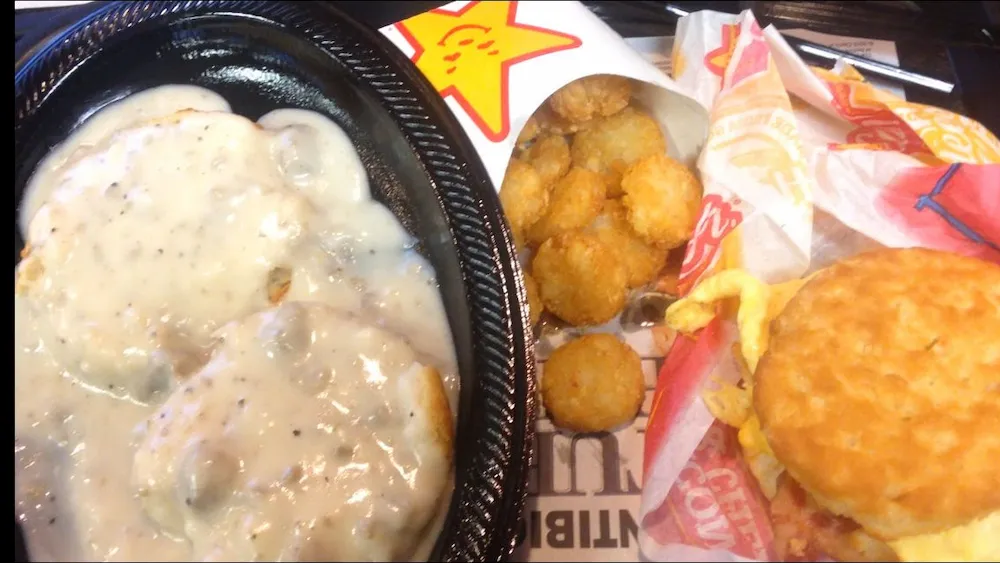
Carl's Jr., known for its burgers, has also innovated with breakfast items, showing the brand's willingness to expand its menu while maintaining quality. Image credit: Laurel Fallon - Own work , CC0, Link
4. Franchise Model Excellence
The Carl's Jr. franchise system has proven to be a massive success with many franchisees operating multiple locations for decades.
The company offers comprehensive support while giving enough flexibility to local operators to succeed in their specific markets.
Carl's Jr. franchise requirements are not just financial metrics and qualifications. Instead, they focus on operational excellence and brand standards to ensure customers get optimum quality.
5. Strategic Transition of Leadership
The current Carl's Jr. CEO is Joe Guith. Guith, as well as his predecessors, have successfully navigated the various challenges in the restaurant industry over the decades.
They have managed to keep the brand thriving and growing, even during economic downturns and changing consumer preferences.
Moreover, the CEO of Carl's Jr. and executive team have maintained the brand's core identity while modernizing operations for optimum efficiency.
All of these efforts have helped the brand meet customer expectations to achieve the massive success it has today.
Lessons for Restaurateurs from Carl's Jr.'s Success
The Carl's Jr. story offers many valuable lessons that restaurants of all sizes and scales can apply:
1. Differentiation Beats Imitation
Carl's Jr. succeeded by being boldly different rather than trying to imitate an already established restaurant chain.
The business became a leader in premium fast food and continues to hold that position.
Who this applies to:
✅ Independent restaurants who are competing against established chains
✅ Brands that want to avoid price-based competition
✅ Operators in saturated markets who need clear positioning to succeed
Who this may not apply to:
⛔️ Concepts where standardization is primary value propositions
⛔️ Markets where pricing is more important than quality
2. Controversial Marketing Can Drive Results
Carl's Jr. commercial campaigns and use of provocative advertising have certainly invited controversies and criticisms, but they generate enormous brand awareness.
The brand's controversies, including the Carl's Jr Paris Hilton commercial, served a strategic purpose of reaching people, instead of just seeking negative attention.
Who this applies to:
✅ Brands with clear target demographics that like bold messaging
✅ Businesses in highly competitive markets where traditional advertising is essential
✅ Companies with strong foundations that can handle public scrutiny
Who this may not apply to:
⛔️ Family-oriented concepts where controversy can alienate core customers
⛔️ Businesses without the resources required to handle potential backlash
⛔️ Brands in conservative markets
3. Strategic Acquisitions Can Boost Growth
The Hardee's acquisition by Carl's Jr parent company helped it achieve national scale while also improving regional brand strength.
This type of dual-brand strategy is not common, but it can provide operational efficiencies with market-specific positioning that might not be possible to achieve for a single brand.
Who this applies to:
✅ Regional chains that are ready for national expansion
✅ Companies with excellent operational systems that can improve acquired brands
✅ Businesses that want to enter new geographic markets efficiently
Who this may not apply to:
⛔️ Operators without the experience of managing multiple brands
⛔️ Companies lacking capital for proper integration and management
⛔️ Businesses where brand confusion can hurt market position
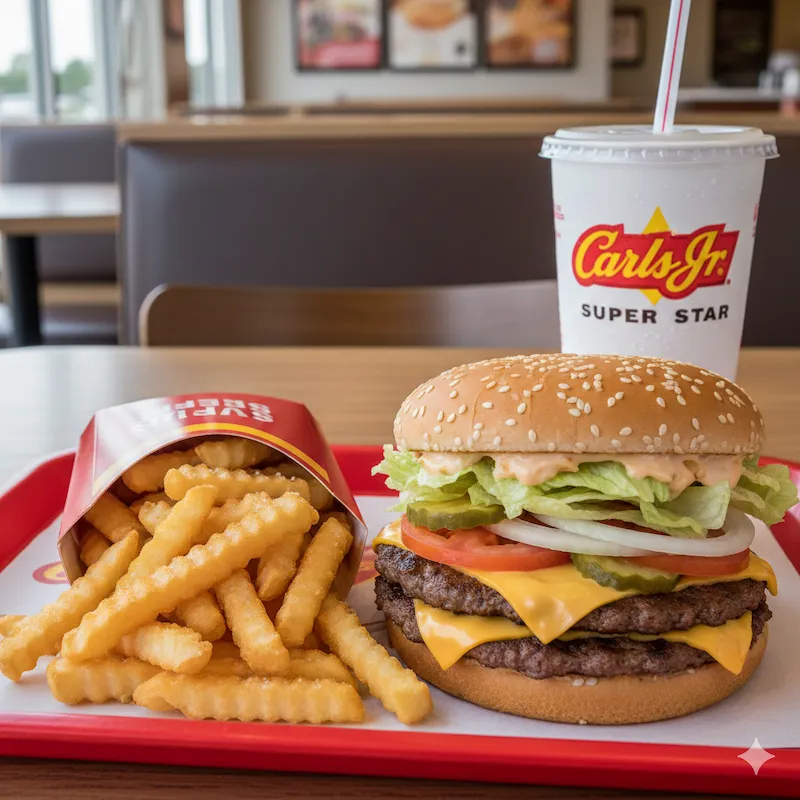
The Super Star with Cheese is one of Carl's Jr.'s most iconic menu items. It represents the brand's commitment to indulgence and quality, which has been a key factor in its success. Note: this image was A.I. generated and may not be an exact representation of the actual menu item, but it captures the essence of Carl's Jr.'s signature offering.
4. Quality Justifies Premium Pricing
Carl's Jr. continues to invest in high-quality ingredients and preparation methods. It teaches restaurants that if they want to charge premium prices, they must be willing to ensure their resources and quality justify the pricing.
Who this applies to:
✅ Restaurants that are positioned above value chains but below fast-casual
✅ Operators with strong supply chain management capabilities
✅ Brands that target customers who prioritize taste and satisfaction over pricing
Who this may not apply to:
⛔️ High-volume concepts where efficiency is more important than premium ingredients
⛔️ Markets where the audience prefers cheaper pricing
5. Founder Transition
Carl Karcher's successful transition from entrepreneur to corporate oversight was vital for the brand's long-term growth.
While it is clear that not every restaurant owner will find themselves managing a business at such a massive scale, it is important for founders to partner with experts to ensure effective management and sustainable growth.
Who this applies to:
✅ Founder-led businesses that are on the limits of personal management capacity
✅ Family-owned restaurants that want to achieve multi-generational success
✅ Businesses ready to scale beyond regional markets
Who this may not apply to:
⛔️ Small operations where founder involvement is essential
⛔️ Businesses where personal relationships drive customer loyalty
⛔️ Concepts still in the process of refining their operational model
Conclusion
Carl's Jr.'s journey from a $311 hot dog cart to a global franchise empire is proof of the fact that lasting restaurant success comes from understanding your target audience and delivering exactly what they want without any compromises.
Carl Karcher's original insight that customers wanted bigger and better burgers and were willing to pay for them has remained the foundation of the restaurant's success.
By focusing on such core values, Carl's Jr. has survived industry consolidation, economic downturns, and changing consumer preferences.
This is an inspirational story of survival and growth for all the restaurants and food businesses that hope to establish a successful empire, even if they are starting out with limited resources.
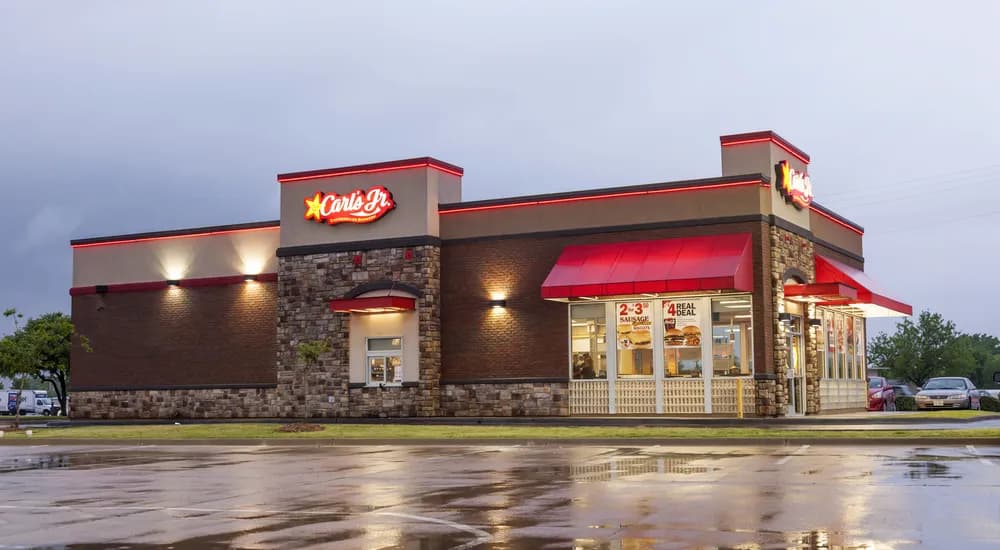
Learn from the success of Carl's Jr. Apply it to your own business strategy.
©2026 Cocina Digital Hospitality Group, Inc. All rights reserved.
No part of this publication may be reproduced, stored in a retrieval system, or transmitted in any form or by any means, electronic, mechanical, photocopying, recording, or otherwise, without the prior written permission of the publisher.